

≈ 22%
Black Adults and Chronic Kidney Disease
Non-Hispanic Black adults (vs. 13% of non-Hispanic White and 12% of Hispanic adults)
- Data year
- Most recent CDC estimate
- Last reviewed
- August 2026

Nicole Washington Ministries — Faith. Strength. Purpose. Still Here.
Faith-based kidney health education, early-detection awareness, advocacy and support for Black patients, families and caregivers.

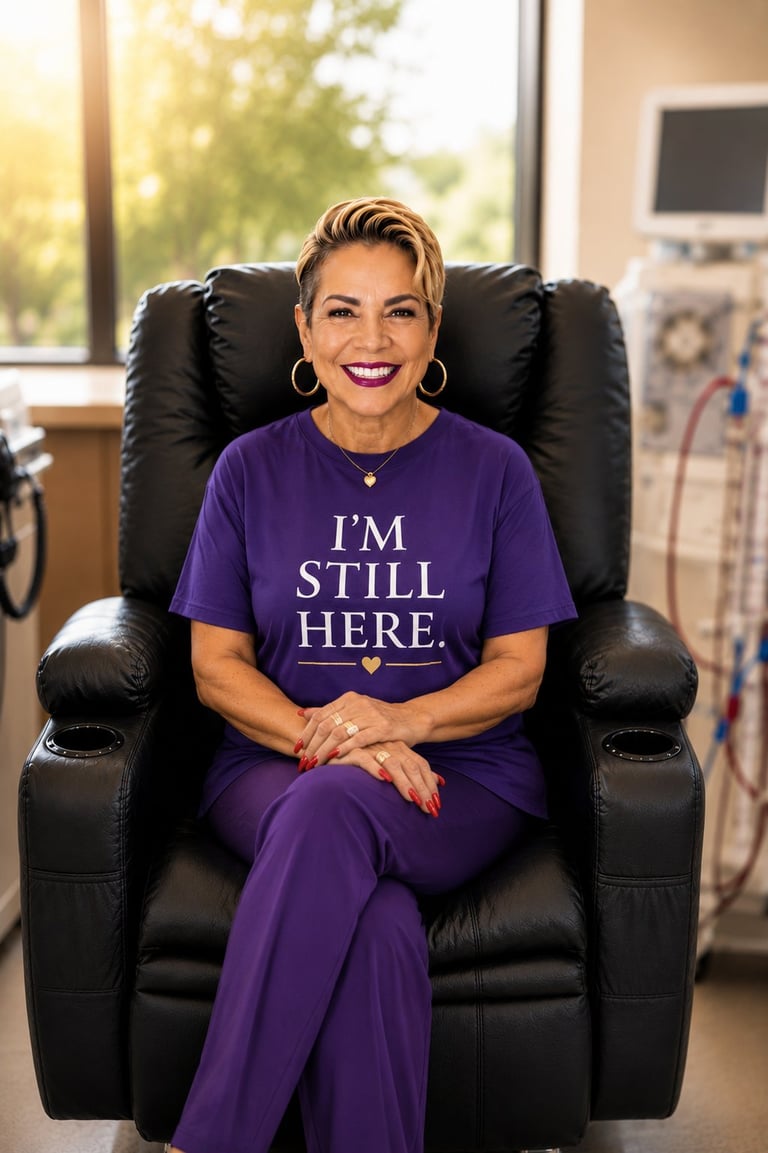
Nicole Washington — living with purpose through kidney failure and dialysis.
Founder's Calling
“I did not choose kidney disease, and I do not believe God sent suffering to teach me. But I do believe God can redeem what we have lived through and use it to help someone else.
I know what it means to build your life around dialysis. I know the exhaustion, the uncertainty, the access complications, the transplant questions and the emotional weight that patients and families carry long after a treatment session ends.
Ministry is my anointing. Helping people affected by kidney disease has become part of my assignment.
IMPACT Black Kidney Health was born from lived experience, pastoral calling and a determination that other patients and caregivers should not have to walk this road uninformed, unsupported or alone.”
Pastor Nicole Washington
Founder, Nicole Washington Ministries
Founder, IMPACT Black Kidney Health
Dialysis Patient and Patient Advocate
Why IMPACT Exists
Black people are more than four times as likely as White people to develop kidney failure. Yet kidney disease can advance without obvious symptoms, leaving too many people unaware until serious damage has already occurred.
Behind every diagnosis is a person. Behind that person may be a spouse, child, parent, caregiver, church family or entire community trying to understand what happens next.
IMPACT Black Kidney Health exists to help people know earlier, ask better questions, locate trusted resources and receive support before and after a health crisis.
Know what to ask. Know your numbers. Know that you are not alone.
Beyond the Treatment Chair
Patients leave treatment carrying more than a medical diagnosis. They may also carry transportation concerns, nutrition questions, employment pressures, transplant decisions, emotional strain, family responsibilities and the daily realities of building a life around kidney disease.
Clinical teams manage treatment. IMPACT strengthens the education, advocacy, navigation, caregiver and community support surrounding it.
We help patients and families understand their options, prepare better questions, locate trusted resources and find encouragement beyond the treatment chair.
Medical care happens in the clinic. Life continues beyond the clinic. IMPACT helps support the person, family and community surrounding that care.
IMPACT Program Areas
Seven ways IMPACT brings education, encouragement and connection to the journey — always in partnership with qualified professionals, never in place of them.
Helping individuals understand kidney function, chronic kidney disease, risk factors, blood and urine testing, dialysis options and questions to discuss with qualified healthcare professionals.
Helping patients prepare for dialysis, understand the roles of their care team, organize questions and navigate everyday life beyond the dialysis chair.
Providing general education about transplant evaluation, waiting-list questions, living donation and the importance of speaking with qualified transplant professionals.
Connecting patients and caregivers with information about transportation programs, nutrition professionals, social workers, insurance assistance, community services and other trusted resources.
Helping caregivers and families understand the emotional, physical and practical realities of kidney disease while reminding them that their own well-being matters too.
Providing prayer, encouragement, peer connection and faith-based support while referring people to qualified mental-health professionals when clinical care is needed.
Bringing understandable kidney-health education into churches, clinics, community centers and trusted neighborhood spaces through presentations, forums, resource events and qualified partnerships.
Any medical screening must be conducted by licensed healthcare professionals or approved healthcare partners. IMPACT provides education and connection — it does not diagnose, treat or determine transplant eligibility.

Reaching the families carrying the heaviest share of this burden.
Who IMPACT Serves
IMPACT Black Kidney Health serves:
IMPACT centers the needs of Black patients, families and communities disproportionately affected by kidney disease while welcoming anyone who needs education, encouragement or connection to appropriate resources.
The Clinic–Church–Community Bridge
Kidney-health education should not begin only after someone reaches kidney failure. IMPACT builds bridges between the places providing medical care and the places where people live, worship, work and gather.
Provide licensed medical expertise, testing, diagnosis and treatment.
Provide trusted relationships, gathering spaces, encouragement and community access.
Provide practical services, local knowledge and connections to people who may otherwise be difficult to reach.
Provides understandable education, patient advocacy, caregiver support, resource navigation and coordination among trusted partners.
When clinics, churches and community organizations work together, people can receive information sooner, ask better questions and connect with appropriate care before a crisis occurs.
Choose Your Next Step
Risk factors, kidney testing, eGFR, urine albumin-creatinine ratio, blood pressure and questions to ask a healthcare professional.
Explore Kidney HealthDialysis education, treatment preparation, care-team information and patient-support resources to help you find your footing.
Find Dialysis SupportTransplant evaluation, waiting-list questions, race-neutral eGFR and living-donor educational resources.
Get Transplant InformationCaregiver support, emotional wellness, practical assistance and caregiver resources — your well-being matters too.
Find Caregiver SupportBring IMPACT education and resources into the community you serve.
Start a PartnershipVisit the Nicole Washington Ministries Prayer Wall and find the ministry support you need today.
Visit the Prayer WallIMPACT Black Kidney Health
What the research says. What is changing.
What Black patients and families need to know.
Kidney health is continually changing. New research, treatments, public policies and healthcare practices can affect how kidney disease is detected, treated and experienced.
But research is not useful if the people most affected cannot understand or access it. The IMPACT Black Kidney Health Research & Trends Center translates important information into clear, practical language for patients, caregivers, churches, advocates and communities. We examine what is happening now, where the numbers may be going and what the evidence could mean for Black families.
Black Kidney Health by the Numbers
Individual, mobile-friendly statistic cards — each with its data year and source — instead of a crowded infographic. Where authorities differ, we show the difference and explain why.
≈ 22%
Non-Hispanic Black adults (vs. 13% of non-Hispanic White and 12% of Hispanic adults)
More than 4× as common
Kidney failure among Black people compared with White people in 2023
18.8%
Percentage of adults with chronic kidney disease — highest among Black adults in the analyzed dataset
Leading risk factor
Hypertension as a major contributor to chronic kidney disease and kidney failure
Leading risk factor
Diabetes as a major contributor to chronic kidney disease and kidney failure
Where you live affects access
Kidney-transplant candidates in medically underserved and primary-care shortage areas
Reading the numbers carefully: different reports can produce different figures because they use different data periods, populations, definitions, laboratory measurements and statistical methods. IMPACT never places two different datasets into one trend line, and never silently selects the more dramatic figure.
One to three carefully selected items each week, newest first. Quality and accuracy come before volume — this is not a daily news feed. Tap a briefing to read more.
Published 2026 · Reviewed by IMPACT: August 2026
A 2026 national study found that kidney-transplant candidates living in medically underserved communities faced greater barriers to being listed for and receiving a transplant before beginning dialysis. Black patients in primary-care shortage areas were particularly disadvantaged.
Why does this matter?
This is why kidney-health outreach must extend beyond dialysis centers. Churches, primary-care offices, community health centers, nephrologists and transplant programs must work together so people receive information and referrals before kidney failure occurs.
What can you ask or do?
Ask a healthcare provider or community health worker how you can get an earlier referral to kidney care — and whether a local clinic can screen your kidney function before kidney failure develops.
Limitations: The study describes national patterns and does not yet provide a precise figure for every local area or jurisdiction.
Source: Community-level disadvantage and access to kidney transplantation before dialysis initiation — Peer-reviewed research (PubMed-indexed)
2026 · Reviewed by IMPACT: August 2026
Published Federal proposal (2025) · Reviewed by IMPACT: August 2026
The Centers for Medicare & Medicaid Services is considering whether dialysis facilities should be evaluated on how well they discuss patients' life goals and incorporate those goals into treatment planning.
Published 2025 · Reviewed by IMPACT: August 2026
New research shows some Black kidney-transplant candidates gained additional waiting-list time after their historical kidney-function results were recalculated without the former race-based adjustment. However, some patients may not have benefited because older laboratory records could not be located.
Older briefings are preserved in the archive above and never disappear when a new one is published. Filter by topic or search to find earlier items.
Where Is Black Kidney Health Headed?
Population changes, diabetes, high blood pressure, access to early testing, new treatments, transplantation policy and community-health efforts can all affect what happens next. IMPACT examines documented trends and credible published projections to help patients, families, churches and community leaders understand the road ahead — and where intervention may change it.
Near-term developments in policy, payment, calculation methods and screening could reshape how kidney care reaches Black patients.
Last reviewed: August 2026
The national kidney-failure burden is expected to grow as diabetes, hypertension and the aging population increase demand for care.
Last reviewed: August 2026
Longer-range scenarios depend on innovation, prevention and whether disparities narrow, remain unchanged or grow.
Last reviewed: August 2026
IMPACT uses cautious language — "the evidence suggests," "if current conditions continue," "researchers project" — and clearly separates a documented trend from a published projection, an IMPACT interpretation, or an opportunity for change. Where an authoritative Black-specific estimate is not available, we say so rather than invent one.
IMPACT Research Reports examine major issues affecting Black kidney health, translate the available evidence and identify practical implications for patients, caregivers, churches, healthcare partners and communities. The first report is in development — including an intended annual flagship, The State of Black Kidney Health. When a report is ready, it will appear here as a downloadable PDF and an accessible web version.
Research Library
Federal data, peer-reviewed research and trusted education — linked to the original source rather than a summary of it.
United States Renal Data System — 2025 Annual Data Report
The authoritative annual report on chronic kidney disease and kidney failure in the United States — including incidence, prevalence and disparities by race.
United States Renal Data System (NIDDK)
2025 · Reviewed August 2026
Chronic Kidney Disease — Data and Statistics
CDC surveillance on chronic kidney disease prevalence, risk factors (including high blood pressure and diabetes), and testing among U.S. adults.
Centers for Disease Control and Prevention (CDC)
Ongoing · Reviewed August 2026
Chronic Kidney Disease — Risk Factors
A plain-language overview of the conditions — especially high blood pressure and diabetes — that most often lead to kidney disease.
Centers for Disease Control and Prevention (CDC)
Ongoing · Reviewed August 2026
Kidney Disease Statistics for the United States
Federal statistics on kidney disease, kidney failure and risk in the United States, with health-information context.
National Institute of Diabetes and Digestive and Kidney Diseases (NIDDK)
Ongoing · Reviewed August 2026
End-Stage Renal Disease — Prospective Payment System
Federal payment and quality policy for dialysis and end-stage kidney disease care, including proposals affecting patients.
Centers for Medicare & Medicaid Services (CMS)
Ongoing · Reviewed August 2026
Organ Procurement and Transplantation Network (OPTN)
The national transplant system — including the waiting list, allocation policies and living-donation information.
Health Resources and Services Administration (HRSA)
Ongoing · Reviewed August 2026
Community disadvantage and access to kidney transplantation
A national study on how medically underserved communities — including Black patients in primary-care shortage areas — face greater barriers to transplant access.
Peer-reviewed research (PubMed-indexed)
2026 · Reviewed August 2026
Black Kidney Health Matters
Curated education and support from the National Kidney Foundation built with Black communities in mind.
National Kidney Foundation (NKF)
Ongoing · Reviewed August 2026
The IMPACT Black Kidney Health Research & Trends Center provides general education, research translation, advocacy information and connections to trusted resources. It does not provide medical diagnosis, individualized medical advice or treatment. Patients should discuss medical questions and treatment decisions with qualified healthcare professionals. Emergency concerns should be directed to 911 or the appropriate emergency service.
IMPACT does not change statistics merely to make the site appear newly updated. If no meaningful weekly development occurs, the current briefing is retained and only the "last reviewed" date changes after confirming it remains current.
Receive the Black Kidney Health Briefing
Receive carefully selected kidney-health research, policy developments, patient resources and future-trend updates from IMPACT Black Kidney Health.

Where kidney-health work meets the people — patient, family, and clinical team together.
Partnership Invitation
IMPACT Black Kidney Health welcomes opportunities to work with churches, dialysis clinics, primary-care practices, transplant programs, hospitals, community organizations and health-equity partners.
Potential collaboration may include
Let's talk about bringing kidney-health education and awareness to the people you already serve.
IMPACT Black Kidney Health is an education, advocacy, ministry-support and resource-navigation initiative of Nicole Washington Ministries. IMPACT does not diagnose medical conditions, provide medical treatment, determine transplant eligibility or replace licensed healthcare professionals. Individuals should discuss medical questions and treatment decisions with qualified healthcare providers. Emergency concerns should be directed to 911 or the appropriate emergency service.
IMPACT provides education about kidney health, connects individuals with trusted resources, offers resource information and encourages patients to discuss their care with qualified professionals — working with licensed partners for any medical screening. IMPACT does not currently provide dialysis treatment, medical screening without licensed partners, nutrition counseling without qualified professionals, licensed social-work services, mental-health treatment, transportation services, medical transplant services, guaranteed financial assistance or guaranteed clinical outcomes.
You Are Not Alone
Whether you are trying to protect your kidney health, beginning dialysis, considering transplantation, supporting someone you love or searching for help in your community, IMPACT Black Kidney Health is here to provide education, encouragement and connection.
Know Early. Live Strong.
IMPACT Black Kidney Health is an education, advocacy, ministry-support and resource-navigation initiative of Nicole Washington Ministries. IMPACT does not diagnose medical conditions, provide medical treatment, determine transplant eligibility or replace licensed healthcare professionals. Emergency concerns should be directed to 911 or the appropriate emergency service.
IMPACT at a Glance
Learn how IMPACT informs, mobilizes, advocates, connects and helps transform communities.

With support, trusted kidney-health education can reach more people where they gather.
What Funding Makes Possible
With philanthropic and institutional support, IMPACT Black Kidney Health can expand its capacity to bring trusted kidney-health education, early-detection awareness, patient and caregiver resources, transplant information, advocacy, and community-based outreach directly to the people who need it. Funding priorities may include:
Get Involved
Whether you are protecting your kidney health, living with kidney disease, caring for a loved one, exploring transplant, or representing a church or community organization, reach out and we will point you to trusted information and next steps.
Ambassadors
Bring kidney-health awareness into the places you already have influence.
IMPACT Ambassadors are community connectors who help bring trusted kidney-health awareness, education, and resources closer to the people who need them. Ambassadors may serve through churches, community organizations, neighborhoods, civic groups, workplaces, support communities, and other trusted spaces.
After completing the appropriate IMPACT orientation/training, Ambassadors may:
Ambassadors do NOT diagnose, treat, screen, prescribe, interpret medical results, or provide individualized medical advice.
We prepare you before we send you.
IMPACT Ambassadors should receive an orientation/training program appropriate to their role. Training should include:
We don't just give you a title. We give you tools.
As the Ambassador program develops, participants may receive an IMPACT Ambassador Toolkit containing approved resources such as:
Ambassadors should be able to participate at different levels — in ways that feel achievable for ordinary community members.
Distribute approved information and help increase kidney-health awareness.
Help individuals and families locate trusted resources and appropriate professional support.
Help bring IMPACT educational conversations into churches, organizations, and community settings.
Help amplify kidney-health awareness and encourage communities to prioritize earlier conversations about kidney health.
As the program develops, IMPACT should be able to document Ambassador activity. Potential measures may include:
You don't need to be a doctor to help someone learn earlier. You need a willing heart, good information, appropriate training, and a commitment to your community.
Become an IMPACT Ambassador