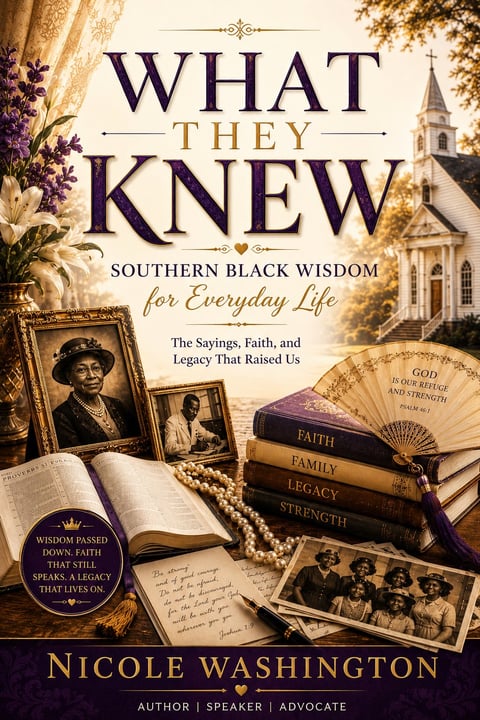
What They Knew
The Wisdom, Faith, and Sayings That Raised Us
By Nicole Washington
Before self-help books. Before podcasts and influencers. There were grandmothers. Church mothers. Fathers and aunties and elders who carried wisdom earned through hardship, faith, sacrifice, and experience — and they passed it to us one saying at a time.
This is a permanent teaching series within the Nicole Washington Ministries Learning Library — preserving the sayings, stories, faith, and wisdom that shaped generations of Southern Black families, connecting each one to the unchanging Word of God.
Start with the Series Introduction — the gateway into the collection.
Why This Series Exists
Some wisdom is too valuable to lose. Some stories are too important to forget. Some lessons still work no matter how much the world changes.
Long before social media. Long before self-help books. Long before podcasts, influencers, and motivational speakers — there were grandmothers. There were church mothers. There were fathers and aunties and elders who carried wisdom earned through hardship, faith, sacrifice, and experience.
They knew how to survive difficult seasons. They knew how to stretch what little they had. They knew how to hold a family together. They knew how to trust God when there was no evidence that things would get better. They knew how to laugh through hardship. They knew how to pray through pain. They knew how to keep going when giving up seemed easier.
This series preserves those lessons for future generations.
Why Black Southern Wisdom Deserves Preservation
This wisdom didn't come from abundance. It came from the opposite. It was forged in Reconstruction's aftermath, under Jim Crow, in sharecroppers' fields and domestic workers' kitchens and segregated schools and steel mills and railroad yards — places where the message from every institution was "you can't."
And yet mothers and fathers gathered their children and said something different. Grandmothers pulled their grandchildren close and spoke hope. Church mothers grabbed young people by the arm after service and refused to let them accept defeat. Teachers in segregated schools taught dignity alongside arithmetic.
They were not perfect people. They carried wounds. Some made mistakes. Their wisdom was sometimes mixed with limitations. But truth spoken by flawed humans is still truth. Courage modeled by wounded people is still courage. Faith lived by broken people is still faith.
We honor them not by pretending they were flawless, but by recognizing that their imperfection did not diminish the truth they carried.
Why These Sayings Matter
These were not cute sayings families collected like souvenirs. This was spiritual survival language. When an elder said "Can't never could," they were not being inspirational in a greeting-card kind of way. They were doing something much more serious.
They were refusing to let their children internalize defeat before the battle even started. They were forming identity. They were teaching faith. They were teaching courage — the kind that gets built when you're a child and someone who loves you refuses to let you give up before you've really tried. They were teaching that refusal is an act of faith.
Every time an elder spoke one of these sayings, they were discipling us — not with sermons, but through correction, repetition, and the weight of their own refusal.
How Scripture Connects to Each Saying
Here is what's remarkable: these sayings — born in the kitchens and cotton fields and church parking lots of Black Southern families — echo throughout Scripture. The phrase itself isn't in the Bible. But the spirit, the refusal, the determination — that runs through biblical faith like a golden thread.
Joshua and Caleb looked at fortified cities and giants and said "we can certainly do it." David looked at Goliath and refused to say "can't" before he'd even tried. Esther walked into a throne room uninvited with the words "if I perish, I perish" — refusing to let fear stop her before she'd even tried.
Biblical faith does not deny difficulty. But it refuses to let difficulty have the final word. That is the difference between despair and faith. And it is exactly what our elders were teaching us — pointing us, whether they knew it or not, toward the God who refuses to let impossibility be the end of the story.
Each teaching in this series unpacks a saying, explores its roots, and connects it to the unchanging truth of Scripture.
The Journey You Are About to Begin
This is not a random list of articles. This is a carefully curated collection that builds from one teaching to the next — each saying a doorway into the faith, resilience, and wisdom of the people who raised us. Each teaching a bridge between what they knew and what God's Word says.
You are entering a permanent digital exhibit. Walk through it slowly. Let the sayings settle. Let the Scripture anchor them. Let the stories remind you whose shoulders you stand on.
Series Contents
Reading Order
Begin with the Series Introduction, then move through each article. Every teaching builds on the one before it.
What They Knew
The Wisdom, Faith, and Sayings That Raised Us
Why this series exists. Why Black Southern wisdom deserves preservation. Why these sayings matter. How Scripture connects to each one. The journey you are about to begin.
What You Will Discover in This Series
Southern Black sayings and their deeper meanings
Faith lessons passed through generations
The Scripture beneath each saying
Life wisdom for everyday challenges
Family traditions worth preserving
Resilience learned through experience
Practical lessons for modern life
The stories behind the wisdom
What the elders were really teaching us
How these sayings point to Jesus
Who This Series Is For
Anyone who grew up hearing "old folks' wisdom"
Families preserving their legacy
Black churches and study groups
Grandparents and grandchildren
Readers interested in culture, faith, and heritage
People searching for practical wisdom
Anyone who believes some lessons should never be lost
Those wanting to understand the faith that sustained generations
They knew things that books never taught. And they passed those lessons to us one story at a time.
— Nicole Washington
Some Wisdom Is Too Valuable To Lose.
The people who came before us knew something — about faith, about survival, about family, about life. And their wisdom still has something to teach us today.
About the Author
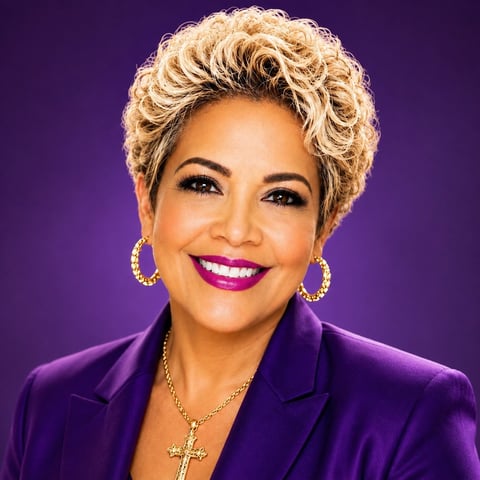
Nicole Washington
Pastor Nicole Washington is an author, Bible teacher, speaker, patient advocate, and founder of Nicole Washington Ministries. With 38+ years of ministry experience and 15+ books in print, she writes and teaches from the middle of real life — illness, caregiving, grief, and the stubborn work of believing God when nothing looks like what you prayed for.